

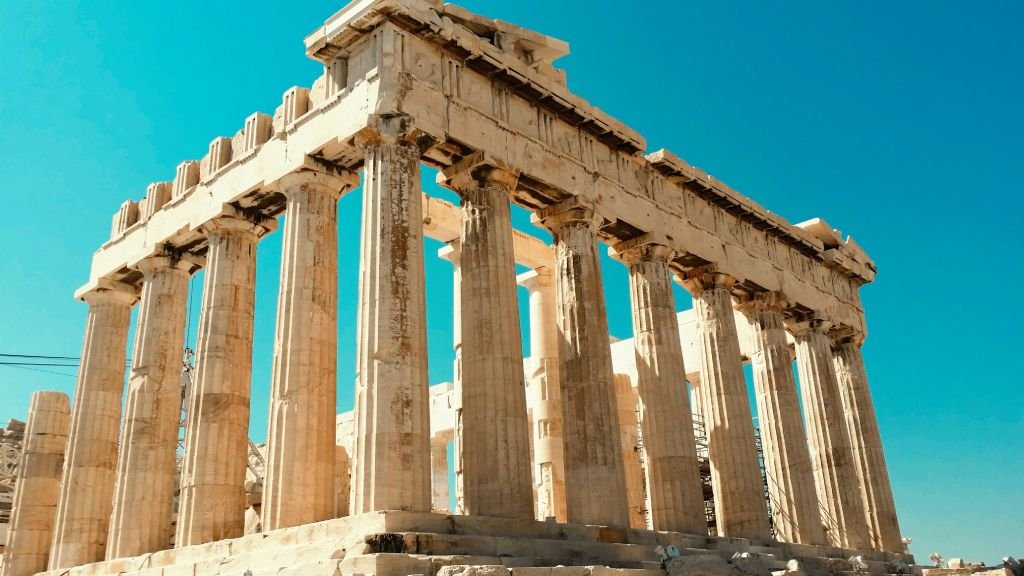
The Greek moment and the freedom to think
In the history of humanity, multiple cultures have existed, each with its vision of the world, its religion, its social organization, and its way of understanding destiny. However, at a precise point in time, a silent event occurred that would profoundly modify the course of civilization.
In ancient Greece, some men began to formulate a different question.
They did not only ask what the gods said.
They asked what reality itself was.
This shift—from myth to logos—did not imply the disappearance of religion, but the emergence of a new space: the space of autonomous thought.
For the first time, the human being allowed himself to seek natural causes, debate publicly, and argue without necessarily resorting to sacred authority. The possibility arose for reason to examine the world without being completely subordinated to religious tradition.
This gesture was not a rejection of the sacred. It was the opening of a complementary dimension: the freedom to think.
Philosophy, science, law, and later Western political organization developed on this basis. The idea that truth can be investigated, discussed, and corrected was born there as a historical possibility.
It was not a linear process, nor was it free of tensions. Even in the West, autonomous thought went through periods of closure. There were moments when religious or ideological authority attempted to restrict research and debate.
But the seed of the logos was already planted.
When thought becomes totally subordinate to a closed religious interpretation—whatever the tradition—the culture loses elasticity. The margin for exploration is reduced, the intellectual horizon narrows, and development becomes repetitive.
History shows that wherever questioning is prevented, the expansion of knowledge stops.
The issue is not religious in itself. Many spiritual traditions have coexisted with deep philosophical thought. The problem arises when the sacred framework becomes an insurmountable limit for all inquiry.
The Greek moment was not simply the birth of a particular civilization. It was the birth of an attitude: the conviction that the human being can interrogate reality with freedom.
This attitude allowed for the development of modern science, complex legal systems, and political forms based on debate and argumentation.
It also allowed for errors, conflicts, and debatable historical expansions. The history of the West is not a narrative of moral purity. It is a complex process, with lights and shadows.
However, the principle that runs through it—the legitimacy of thinking beyond imposed margins—constitutes one of the most decisive facts of human development.
Today, in different parts of the world, this freedom remains fragile. Not only in the face of closed religious forms, but also in the face of secular ideologies that try to set absolute limits on thought.
To remember the Greek moment is not to exalt one civilization over another. It is to remember that the freedom to think is a historical conquest that can be lost.
And that every culture that aspires to develop needs to preserve that space.
Because when the human being ceases to be able to question, he also ceases to be able to create.